Compliance that runs inside your AI system, not beside it.
Aevoxis builds the engineering layer of the EU AI Act. Start with Article 50: tell people when they're talking to AI and mark AI-generated content, which has applied since August 2026. Then extend the same components to the high-risk duties of Articles 12–14 (logging, transparency, human oversight) before December 2027.
Article 50: transparency, required today
Article 50 has applied since 2 August 2026. If your product talks to people or generates content, these duties are live now, and each one is a change in the product rather than a page in a policy document.
Art. 50(1)
Tell people it's AI
People must be told when they're interacting with an AI system, such as a chatbot or voice agent. Aevoxis adds the disclosure in the product and logs that it was shown.
Art. 50(2)
Mark AI-generated content
Synthetic text, images, audio and video must carry a machine-readable marking. Aevoxis applies it at generation time and records it.
Art. 50(4)
Disclose deepfakes
Deployers must disclose AI-generated or manipulated content that looks real. Aevoxis makes the disclosure part of the publishing flow.
Built on Vinita's published research on implementing Article 50 (two SSRN preprints): Article 50 compliance for generative AI systems: six open implementation questions; Article 50 compliance for agentic AI: nine unresolved engineering questions.
Next: high-risk duties in the code path (Articles 12–14)
The same logging and oversight components extend to the high-risk obligations that apply from 2 December 2027.
Most compliance work treats these articles as paperwork. That breaks down fast. Logs that were never captured can't be produced for an auditor, and an override button nobody is forced to use is not oversight. So Aevoxis builds each obligation into the system itself.
Article 12
Record-keeping
Every input, output and decision is logged automatically while the system runs. Each record carries a SHA-256 hash, so any later edit is detectable.
Article 13
Transparency
Deployers see why an output was produced, in the interface they already use. Not in a log file nobody opens.
Article 14
Human oversight
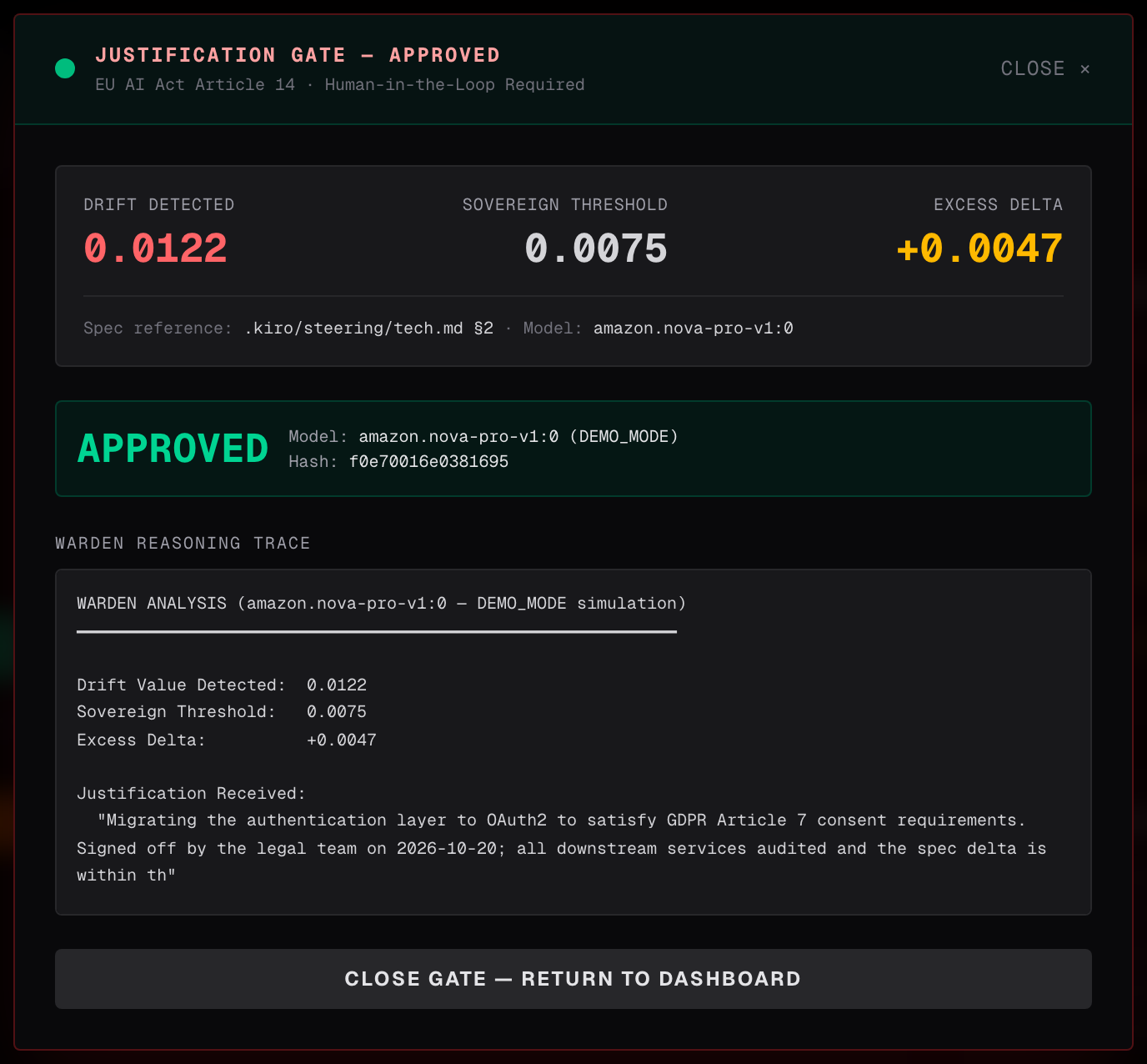
When outputs drift from the approved specification, a Justification Gate stops the system until a person records a reasoned decision.
Working prototype
The Spec-Drift Chronometer
It measures how far an AI system's output has drifted from a human-approved specification. Past the threshold, the Justification Gate stops the system and asks a person to decide. A weak answer like "it is fine" is rejected, and the rejection is logged too.
It was built for the AWS 10,000 AIdeas Competition 2025 on AWS Lambda in Frankfurt (eu-central-1), with Amazon Bedrock for the reasoning step, and placed in the Top 300 out of more than 10,000 entries. The public demo now runs on Render; the AWS path stays in the code for production deployments.
To be clear about what you'll see: the public demo uses scripted drift scenarios. The gate, the audit trail and the specification vault are fully working.
- 1
Specify
A person writes and approves the specification. The AI system can read it but never edit it.
- 2
Measure
Drift against the specification is checked every few seconds.
- 3
Stop
Past the threshold, the Justification Gate halts the system.
- 4
Decide
A person records a reasoned decision. Weak justifications are rejected.
- 5
Prove
Every step lands in a hash-verified audit trail you can export.
Try the open-source tools
Two of the building blocks are on PyPI, so you can install them and read the source before talking to anyone.
Selected work
One client project and two worked examples. Each is labelled for what it is.
Client work, 2025
Scoping an in-house AI support chatbot
Why a vendor chatbot fell short, a Rasa and Claude design, and a four-week pilot with one success metric.
Read itIllustrative redesign
Then and now: keeping people in charge of hiring
A real 2017 hiring round, redesigned under the EU AI Act, GDPR and AGG. People decide; AI only does the paperwork.
Read itWorked examples
Illustrative EU AI Act scenarios
How I'd approach Article 50 disclosure, content marking, logging and human oversight. Invented companies, not client work.
Read itWho it's for
Article 50, today
Any company offering a chatbot, voice agent or AI-generated content to people in the EU, including companies based outside the EU.
Articles 12–14, from December 2027
Teams that build or deploy high-risk AI systems in the EU, in any industry. If your system makes or shapes decisions like these, Articles 12–14 apply to you:
- Screening job applicants or ranking candidates
- Credit scoring and creditworthiness checks
- Scoring exams or steering access to education
- AI safety components in machinery and other regulated products
Why now
- 2 Aug 2026Transparency rules (Article 50) apply and enforcement starts
- 2 Dec 2026Deadline for AI systems already generating synthetic content (Article 50(2))
- 2 Dec 2027High-risk rules (Annex III) apply, including Articles 12–14
- 2 Aug 2028High-risk AI in regulated products (Annex I) follows
Source: European Commission, AI Act Service Desk (dates after the Digital Omnibus on AI)
Logging can't be added afterwards. The data needed to reconstruct a decision has to be captured from the first day the system runs, so the earlier it's built in, the cheaper it is.
Need it sooner? I take on a small number of engineering engagements for Article 50 and Articles 12–14 while the product is in development.
Questions
Does Article 50 apply to companies outside the EU?
What does Article 50 of the EU AI Act require?
What do Articles 12, 13 and 14 of the EU AI Act require?
Why build this into the system instead of writing a policy?
Is Aevoxis a law firm?
Built by an engineer, not a policy team
I'm Vinita Silaparasetty, an AI Governance Engineer and Google Developer Expert in Machine Learning. I build Aevoxis because most AI failures I see are architecture failures. They can be fixed in the design, long before they become legal problems.